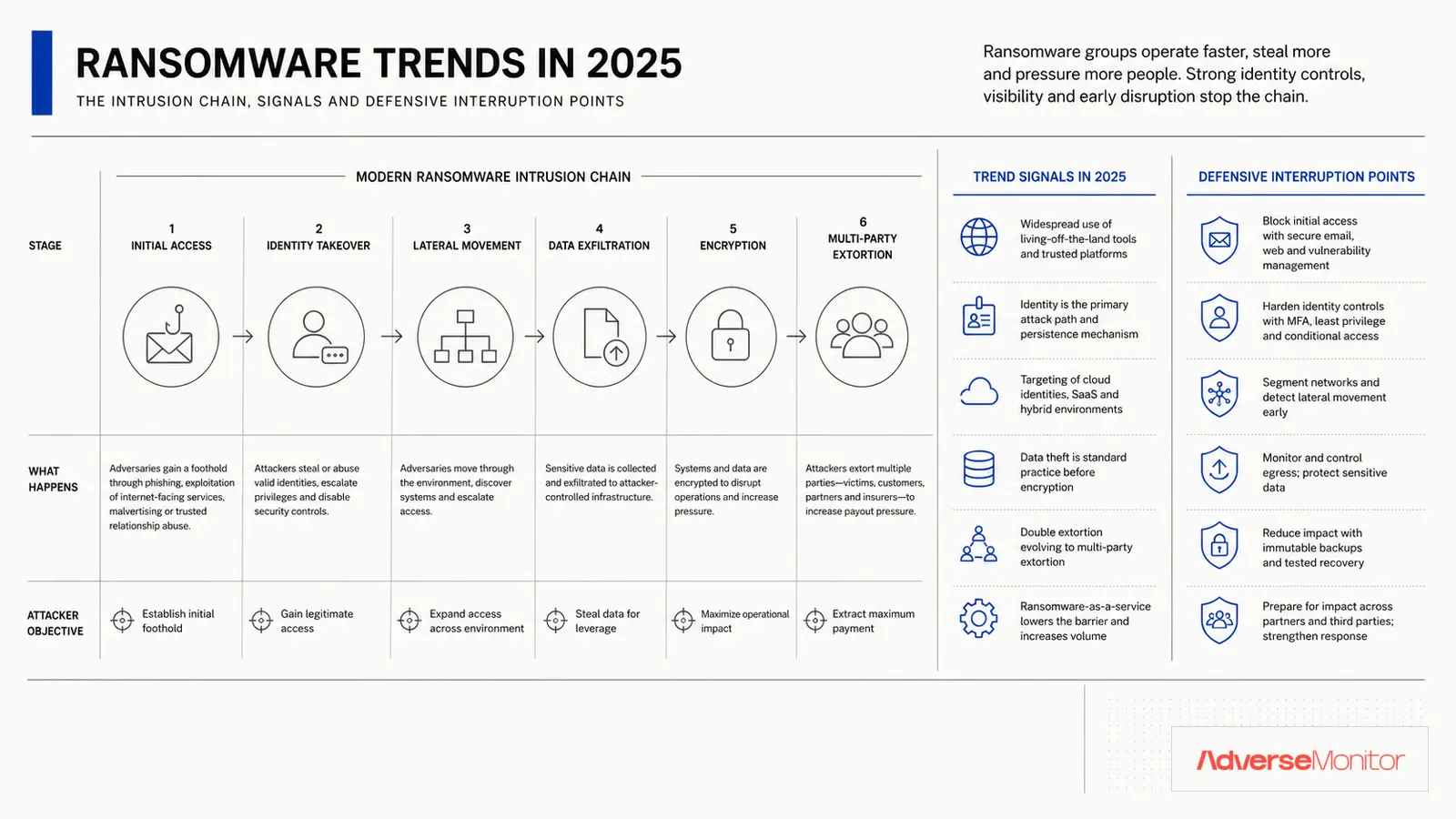
Ransomware groups now pair encryption with data theft. They also pressure third parties and buy network access from specialist brokers. Each of these tactics changes how your team should prepare for an incident.
Costs and current scale
What an attack can cost
Costs go beyond any payment demand. They can include:
- Downtime
- Recovery work
- Legal work
- Notification
- Lost business
IBM's 2024 Cost of a Data Breach report gives one benchmark. In it, IBM reported a $4.88 million global average total cost per breach. That figure averages all breach types, so it is not a ransomware number. Estimate each cost above from your own systems and obligations.
How often ransomware shows up
Ransomware still makes up a large share of publicly posted incident claims. In the AdverseMonitor H1 2026 threat data study, 4,502 of 29,858 collected records (15.1%) fell in the Ransomware category. Only DDoS Attack and Data Breach had more records.
Each record is one collected source observation. A record on its own does not prove that an incident took place.
The ten sections below cover tactics and operating changes that ransomware groups have used in recent years. Most of them remain in use. Treat the list as a checklist for your current plan, since it covers more than one year.
1. Double and triple extortion are now standard
Older ransomware encrypted files and charged a fee for the key. With double extortion, attackers also steal data and threaten to publish it. Established groups use this tactic as routine.
The three layers of pressure
Triple extortion adds direct pressure on customers, partners, or other stakeholders. The layers stack up:
- Attackers encrypt the victim's systems (traditional ransomware).
- They threaten to publish stolen data if the victim does not pay (double extortion).
- They threaten the victim's customers, partners, or stakeholders directly (triple extortion).
In a triple-extortion case, attackers contact the victim's customers and threaten to publish their information. That contact adds pressure even if the main victim refuses to pay.
Trend Alert:
BlackCat/ALPHV and LockBit are among the groups that have advertised triple-extortion capabilities. Some kept databases of victim customers so they could contact those customers directly.
2. Ransomware-as-a-Service (RaaS) widens access
RaaS platforms lower the skill an attacker needs. Operators license malware and infrastructure to affiliates, and the affiliates carry out the attacks.
How the RaaS model works
The model works like a normal SaaS business:
- Affiliates (attackers) license ransomware from operators (developers).
- Affiliates run attacks with the ransomware they licensed.
- Operators and affiliates split the proceeds on terms the criminal service sets.
- Operators provide leak sites, negotiation support, and payment processing.
This split of work gives less experienced affiliates ransomware that specialist operators build and support. LockBit, BlackCat, and Hive have all used the RaaS model.
3. Initial access brokers fuel attacks
Initial Access Brokers (IABs) break into networks and sell that access to other attackers. They may exploit a vulnerability or obtain valid credentials. Then they advertise the access on underground forums.
What IABs sell
- VPN credentials for corporate networks
- Remote Desktop Protocol (RDP) access
- Webshells on compromised servers
- Valid domain administrator credentials
What this means for your team
A ransomware operator may buy existing network access. That saves them the work of gaining the first foothold.
Your team has to watch for direct intrusion attempts. You also have to look for access that another attacker set up before the ransomware operator arrived.
4. Supply chain and third-party targeting
One compromised software vendor or service provider can expose many of its customers. Ransomware groups use this route to reach organizations through a shared supplier.
Supply-chain incidents can involve:
- Managed service providers
- Software vendors
- Cloud infrastructure providers
In its 2024 Data Breach Investigations Report, Verizon reported that 15% of breaches involved third-party suppliers. Include any vendor with system or data access in your security reviews and incident plans.
5. Faster attacks, less dwell time
Some ransomware operators move fast from first access to data theft and encryption. Measure how long your own team takes to detect and contain an attack.
This "smash and grab" approach shrinks the window for detection and response. Build your response plan for attackers who may not stay hidden for long.
Automated exploitation
Opportunistic attackers can scan for a disclosed vulnerability and automate the exploit. Use your organization's exposure and change process to set the patch priority.
Speed Matters:
In its 2024 DBIR, Verizon reported that 68% of cases where data exfiltration occurred took days or less to complete. Periodic reviews leave gaps between review dates. Add ongoing detection controls where the system's risk and response needs justify them.
6. Targeting specific industries
Some ransomware groups specialize by industry.
Healthcare
Patient care, sensitive records, and service uptime can raise the pressure during an incident. The incident lead, legal counsel, and relevant authorities own any payment decision.
Financial services
Banks, insurers, and fintech firms face advanced attacks. They hold valuable data. Regulators also press them to keep running and to protect customer information.
Legal firms
Law firms hold sensitive client information and intellectual property, which makes them prime targets for extortion. Client privilege concerns add more pressure to pay.
Manufacturing
Production outages can cause large operating losses. Estimate the impact from the affected site's own production and recovery data.
Education
Universities and schools hold research data and student records. Many have small security budgets, which makes them attractive soft targets.
7. Cryptocurrency remains the preferred payment
Law enforcement watches crypto payments and has seized funds. Attackers still ask for cryptocurrency, mainly Bitcoin and Monero.
Reported payment practices
- More use of privacy coins like Monero, which are harder to trace
- Advanced laundering through mixers and exchanges
- Some groups accept other forms of payment or other cryptocurrencies
- Growing use of cryptocurrency ATMs for anonymity
Risks of paying
A ransom payment may require you to handle cryptocurrency. It can also raise sanctions concerns. Paying does not guarantee that you get your data back or that the attackers delete it.
8. Data destruction and wiper attacks
Some attacks with geopolitical motives use data-wiping malware disguised as ransomware. The malware destroys the data instead of holding it for payment.
Reports also describe profit-driven groups destroying data after a victim refuses to pay. Tested offline backups give you a recovery path when you cannot restore the data from production systems.
9. Groups reorganize after law-enforcement action
International law enforcement has seized infrastructure, arrested operators, and recovered cryptocurrency. Some affiliates keep working under another group after a disruption.
After actions against operations such as Hive or BlackCat, some operators and affiliates came back under new names. A takedown may disrupt an operation without removing everyone in it.
Your organization still needs its own prevention, detection, and recovery controls after a takedown.
10. Artificial intelligence in ransomware operations
Attackers and defenders both use AI tools. Reported attacker uses include:
- AI-written phishing emails with better grammar and personalization
- Automated vulnerability scanning and exploitation
- Machine learning to find high-value targets and data
- AI-assisted social engineering and impersonation
Ransomware operators may use easy-to-reach AI tools for reconnaissance, initial access, and social engineering.
Protecting your organization
The ten controls below address the tactics above. We have grouped them by the job they do.
Limit access
- Zero Trust Architecture: Assume a breach has happened. Limit lateral movement with network segmentation and least-privilege access.
- Multi-Factor Authentication: Apply MFA according to your identity policy. Start with VPN, email, and administrative access.
Reduce the ways in
- Risk-Based Patching: Let the vulnerability and change owners rank an exposed critical flaw. They should weigh evidence of exploitation, asset exposure, and operational risk.
- Employee Training: Regular security awareness training reduces phishing success. Phishing is a common initial access vector.
- Third-Party Risk Management: Assess vendor security, require security standards in contracts, and monitor vendors for breaches.
Detect attackers early
- Dark Web Monitoring: Investigate matches that involve your organization on leak sites or credential forums.
- Endpoint Detection and Response (EDR): Deploy EDR tools that can detect and respond to ransomware behavior patterns.
- Network Monitoring: Use continuous monitoring to spot unusual lateral movement, data exfiltration, or traffic to known malicious infrastructure.
Prepare to recover
- Offline Backups: Keep immutable, offline backups that ransomware cannot encrypt. Test restores on a regular schedule.
- Incident Response Planning: Keep tested IR plans that include ransomware scenarios. Know who to call and what to do before an attack starts.
Conclusion
Ransomware can halt operations, expose regulated data, and create legal and recovery costs. Business leaders need to plan for those effects alongside the technical response.
Core controls include patching, tested backups, access control, and monitoring. Each one covers a different stage of the attack.
Attackers can still get past preventive controls. Detection and a tested response plan limit the time they spend inside your environment.
Next steps
- Review your plan against the ten tactics above.
- Assign an owner to each control.
- Test recovery before an incident.