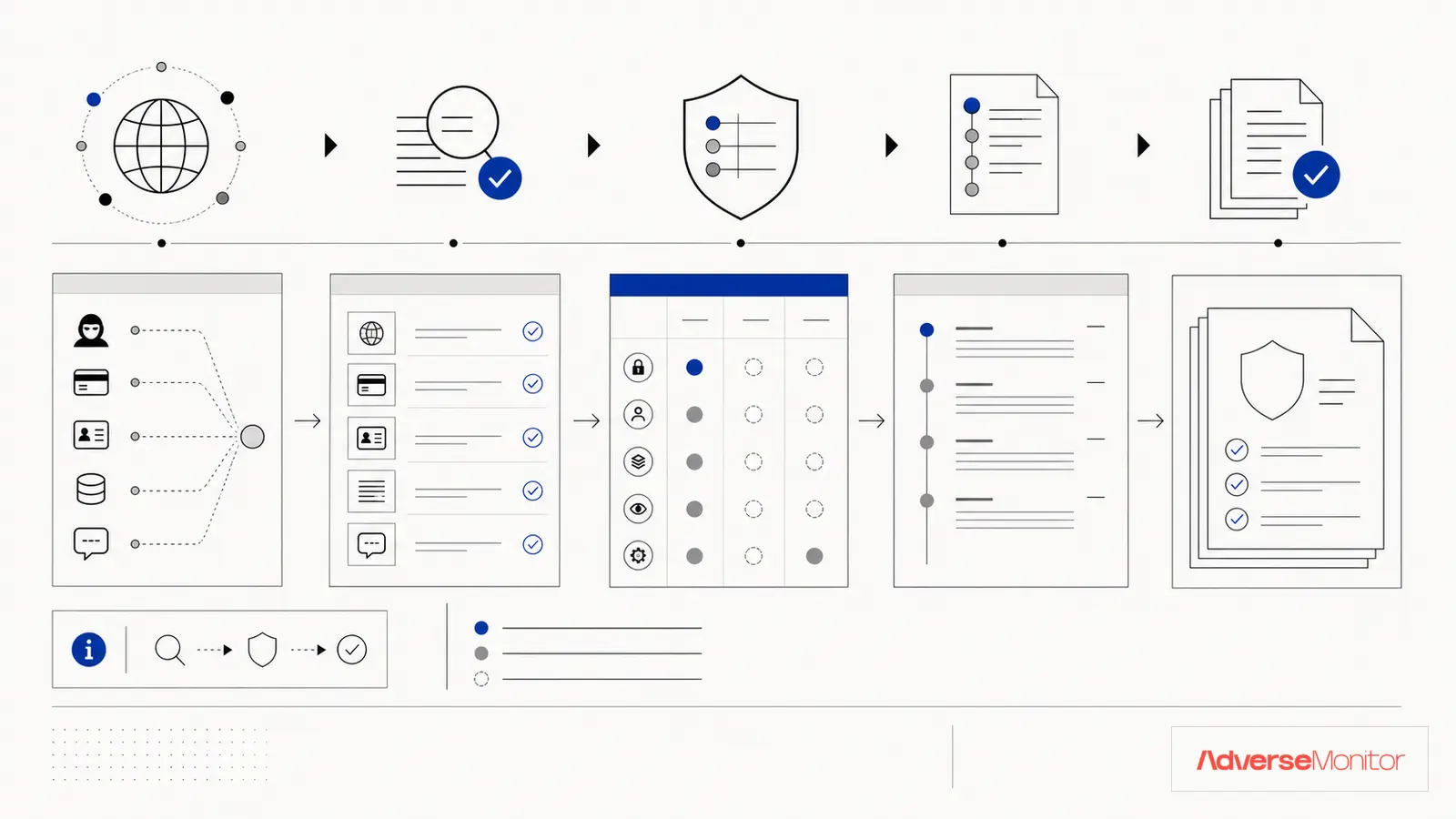
An auditor may ask how the organization monitors external threats, handles possible credential exposure, and records its response. Answer with the controls and evidence the organization operates.
SOC 2, GDPR, HIPAA, and PCI DSS do not become satisfied because an organization buys dark web monitoring. A monitoring record may support an existing detection or investigation process when the team documents how it reviews and acts on that record.
Where Monitoring Records May Fit
Most compliance frameworks do not explicitly require "dark web monitoring" by name. An organization may map its monitoring workflow to broader practices such as:
- Threat and vulnerability management: Identifying and responding to security threats
- Incident detection and response: Detecting security incidents in a timely manner
- Risk management: Understanding and mitigating cybersecurity risks
- Breach notification: Becoming aware of data breaches quickly enough to meet notification deadlines
- Third-party risk management: Monitoring vendors and partners for security incidents
A verified vendor-related record may contribute to a third-party review, alongside contracts, questionnaires, penetration-test results, and direct assurance evidence.
SOC 2 and Dark Web Monitoring
A SOC 2 mapping should connect the actual monitoring workflow to the applicable Trust Services Criteria and the auditor's evidence requirements.
Use the criteria in your actual engagement
SOC 2 evidence depends on the system description, selected Trust Services Criteria, control wording, and auditor. Do not copy a generic control number into the evidence map.
Possible evidence: Configuration records, review logs, investigation outcomes, and incident tickets can show how the organization handles external-source matches. A matching record does not establish that the event affected the organization's systems.
What Auditors Want to See
During a SOC 2 audit, be prepared to demonstrate:
- Monitoring configuration: What sources are monitored, what keywords/domains are tracked
- Alert delivery: How threats are communicated to security teams
- Response process: What happens when a threat is detected
- Historical evidence: Logs showing continuous monitoring over the audit period
- Effectiveness metrics: Evidence that threats were detected and addressed
GDPR and Breach Notification Requirements
GDPR Article 33 applies when a controller becomes aware of a personal-data breach. Notification to the supervisory authority is required without undue delay and, where feasible, within 72 hours, unless the breach is unlikely to create a risk to people's rights and freedoms.
Article 33 ties the notification period to awareness of a personal-data breach. A monitoring match is an investigation lead; legal counsel should determine when the organization has the awareness that triggers a notification duty.
How Dark Web Monitoring Supports GDPR
- Investigation lead: A collected leak-site or forum record may prompt a review, but collection latency, identity matching, and source credibility vary.
- Control evidence: The configuration and review log may contribute to evidence of the organization's technical and organizational measures when the assessor accepts the mapping.
- Third-party monitoring: Helps you detect when processors or sub-processors experience breaches affecting your data.
- Documentation: Alert logs provide timestamped evidence of when you became aware of potential breaches, supporting your notification timeline.
Do not infer a legal deadline from an alert alone. Record when the match arrived, what it contained, how it was verified, and when the controller became aware of a personal-data breach. Counsel should apply Article 33 to those facts.
Meeting the 72-Hour Requirement
Without dark web monitoring, you might not discover a breach until:
- Customers complain about fraudulent activity (weeks or months later)
- Law enforcement notifies you
- Security researchers find your data circulating online
- Annual penetration testing uncovers evidence
A monitoring match can start an investigation. It does not by itself decide when the legal awareness threshold has been met.
HIPAA and Protected Health Information (PHI)
The HIPAA Security Rule requires covered entities and business associates to use reasonable and appropriate safeguards for electronic protected health information. The required risk analysis is broader than monitoring an external source.
§164.308(a)(1)(ii)(A) - Risk Analysis
"Implement security measures sufficient to reduce risks and vulnerabilities to a reasonable and appropriate level."
Possible evidence: A record that appears to contain PHI can prompt a scoped investigation. The organization must verify the data, source, and affected individuals before treating it as a HIPAA breach.
§164.308(a)(6) - Security Incident Procedures
"Implement policies and procedures to address security incidents."
Possible use: A verified match can enter the entity's security-incident process. The entity still needs to establish whether protected health information was involved and whether the event meets the rule's definition of a breach.
HIPAA Breach Notification Rule
The HHS Breach Notification Rule guidance explains notice to affected individuals, HHS, and, in some cases, the media. HHS reporting applies to breaches above and below 500 individuals, with different timing. A monitoring match is not a breach determination.
- Detecting PHI exposure on dark web markets or forums
- Identifying compromised employee credentials that could lead to unauthorized PHI access
- Monitoring for ransomware attacks targeting healthcare organizations
- Providing documentation of when PHI compromise was discovered
PCI DSS and Payment Card Data Protection
PCI DSS does not prescribe dark web monitoring as a standalone control. A qualified assessor should decide whether a particular workflow supplies evidence for the entity's scoped requirements.
Use the current PCI DSS version
In PCI DSS v4.x, payment-page change and tamper detection is addressed in Requirement 11.6.1. It is not evidence that an external-source monitoring product is required.
Keep the incident plan separate
A verified record may enter the incident process. The organization's current assessment scope and incident plan determine the response and evidence.
How dark web monitoring helps:
- Detects when payment card data appears on dark web carding forums
- Alerts you to mentions of your organization in initial access broker discussions
- Monitors for compromised payment processing infrastructure credentials
- May contribute review logs to a QSA assessment when the evidence maps to an applicable control
Building Compliance-Ready Documentation
Keep evidence of what the team configured, received, reviewed, and decided:
Policy Documentation
- Threat monitoring policy: Document your commitment to external threat monitoring
- Scope definition: What entities, domains, keywords are monitored and why
- Response procedures: What happens when threats are detected
- Roles and responsibilities: Who receives alerts and who is responsible for response
Operational Evidence
- Alert history: Documented log of all alerts received during the audit period
- Response records: Evidence of how alerts were triaged and addressed
- Configuration screenshots: Proof of what's being monitored
- Vendor documentation: SOC 2 report from your dark web monitoring provider (if available)
Metrics and Reporting
- Uptime/availability: Evidence of continuous monitoring
- Mean time to detection: How quickly threats are identified
- Response times: How quickly your team acts on alerts
- Threats prevented: Documented examples of threats detected and mitigated
Reviewable Monitoring Records
AdverseMonitor provides application activity and alert history that may support your evidence collection. Confirm suitability with your auditor; AdverseMonitor does not publish a SOC 2 report.
Check a DomainCyber Insurance Requirements
Cyber-insurance applications and policy conditions differ by insurer and renewal. Check the current form and policy wording before treating dark web monitoring as a required control.
- Lower breach frequency and severity
- Faster incident detection and response
- Better overall security posture
If an application asks about dark web monitoring, answer with the service actually in use, its scope, and the review process. Do not assume that one answer changes premiums or coverage.
Industry-Specific Considerations
Financial Services (GLBA, FFIEC)
Financial institutions can use a verified external-source match as one input to incident or fraud review. The institution and its assessor should decide whether that workflow maps to FFIEC, BSA, or AML obligations.
Government Contractors (CMMC, NIST 800-171)
Organizations handling Controlled Unclassified Information (CUI) map evidence to NIST 800-171 controls, including SI-4 and IR-4. A dark web record is useful only when the documented workflow satisfies part of the selected control and the assessor accepts it.
Education (FERPA)
An educational institution may investigate a record that appears to contain student data. It still needs to verify the disclosure and apply its FERPA process.
Common Auditor Questions and How to Answer
Q: "How do you monitor for external threats to your organization?"
A: Describe the sources the provider actually covers, the configured terms, measured delivery time, and the team that reviews each match.
Q: "How quickly would you know if your data appeared in a breach?"
A: Report measured collection-to-review times from your own records. Do not substitute an untested "real-time" claim.
Q: "Can you demonstrate your threat monitoring over the past 12 months?"
A: Show the actual configuration history, received records, review decisions, and resulting incident tickets for the audit period.
Use the Evidence You Can Prove
Dark web monitoring does not prevent a breach or establish compliance. It can produce records that support a documented detection and investigation workflow.
Map each record, review step, and response ticket to a control only after the compliance owner or assessor confirms the relationship.
Give the auditor the configuration, source scope, timestamps, reviewer decisions, and follow-up evidence. Let that record show what the control did.
Official References
- EUR-Lex: General Data Protection Regulation, including Article 33
- HHS: HIPAA Breach Notification Rule
- HHS: Guidance on Risk Analysis
- PCI Security Standards Council: PCI DSS