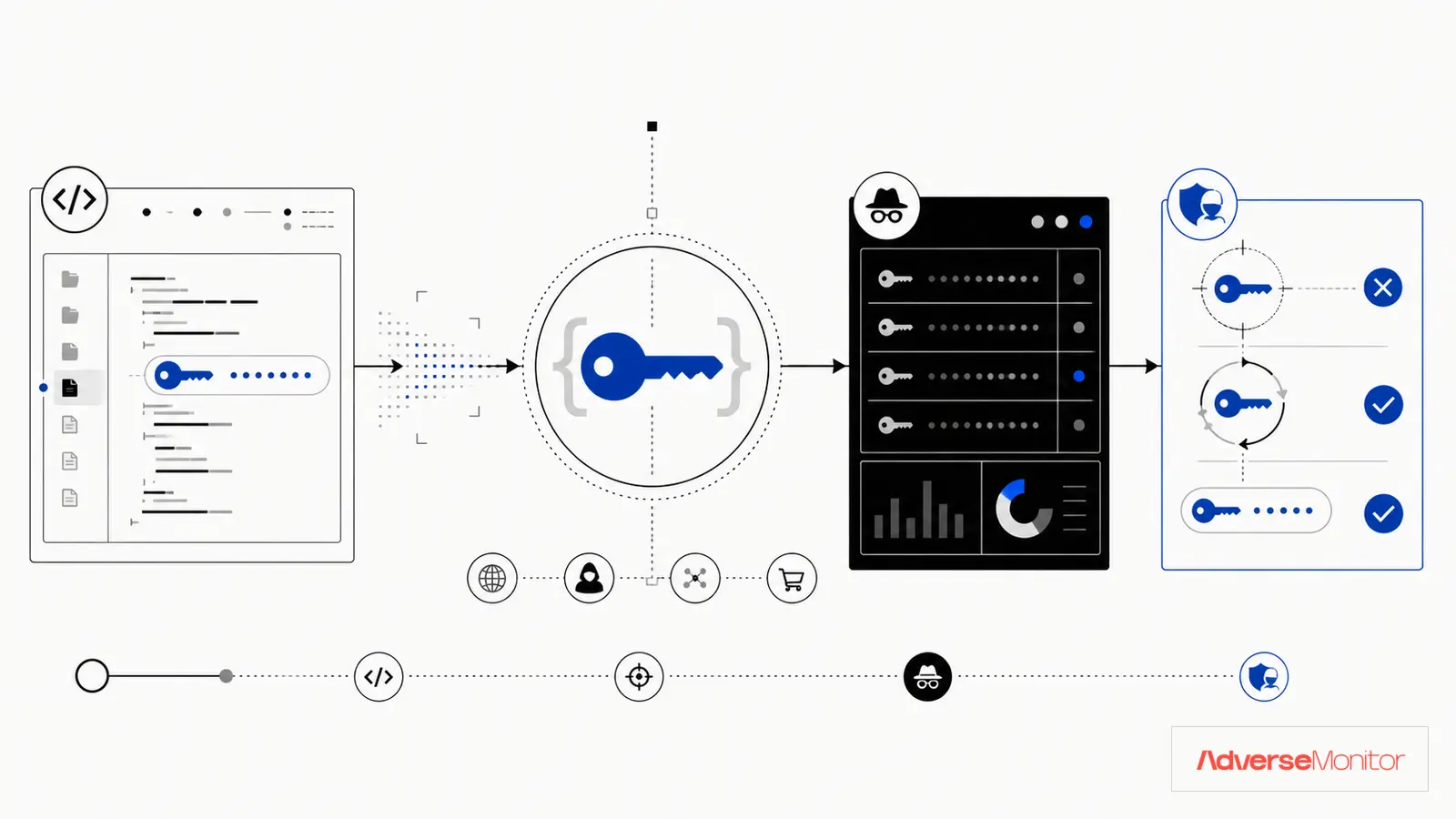
Mobile apps, SaaS products, and cloud services use APIs to exchange data and trigger actions. A leaked credential exposes only the permissions attached to that key, but broad permissions can give an attacker substantial access.
API credentials can appear in public code, paste sites, configuration files, or forum posts. After verification, the assigned incident-response owner follows the organization's containment runbook and reviews the credential's access logs.
How API Credentials End Up Exposed
1. Hardcoded in Source Code
Developers can commit API keys, database credentials, and cloud access tokens to public repositories by mistake. Public code is searchable, so a committed secret should be treated as exposed until the owner verifies otherwise.
2. Misconfigured Cloud Storage
Publicly accessible cloud storage can expose configuration files with embedded API keys. Storage-policy checks and secret scanning can identify this path before an external report arrives.
3. Mobile App Decompilation
API keys embedded in mobile applications can be extracted through reverse engineering. Attackers decompile APKs and IPAs to extract hardcoded credentials.
4. Third-Party Breaches
When a third-party service is breached, integration credentials may be exposed. Their impact depends on scope, expiry, network controls, and the authorization enforced by the receiving service.
5. Insider Threats
Disgruntled employees or contractors with access to API credentials may intentionally leak them to dark web forums or sell them to competitors.
What Attackers Do With Exposed API Keys
A valid credential may allow the actions granted by its permissions:
Data Exfiltration
An API key with data-read permissions may expose customer records, financial data, or proprietary information. The accessible scope depends on the key's permissions and the API's authorization checks.
Resource Theft
Exposed AWS, Azure, or Google Cloud credentials may allow unauthorized compute workloads or other resource use. Billing alerts and cloud audit logs can show whether the credential was used.
Service Manipulation
With API access, attackers can modify application behavior, inject malicious content, manipulate user accounts, or disrupt services entirely.
Privilege Escalation
Initial API access serves as a foothold for deeper system compromise. Attackers use API endpoints to discover vulnerabilities and escalate privileges.
Supply Chain Attacks
Compromised API credentials can enable attacks against your customers. If your API provides services to other businesses, those businesses inherit your security exposure.
Scope determines impact. Review the key's permissions, expiry, recent calls, and the data available through each authorized endpoint.
Real-World Examples
Uber (2016): Attackers used cloud credentials found in a repository to reach additional company data. The case shows why repository secrets and their downstream permissions need separate controls.
Tesla (2018): Hackers found exposed Kubernetes credentials, accessing Tesla's cloud environment to mine cryptocurrency.
Twilio (2022): Exposed API credentials enabled attackers to access customer data and send phishing messages to Authy users.
API Security Best Practices
1. Keep Credentials Out of Source Code
Use environment variables, a secrets manager, or CI/CD secret injection. Block credential commits with repository controls and secret scanning.
2. Implement Short-Lived Tokens
Set token expiry according to the threat model and the time a service needs to complete its work. Define rotation and revocation rules for suspicious activity.
3. Scope API Keys Appropriately
Apply least-privilege principles. API keys should have the minimum permissions necessary. Create separate keys for different services rather than one key with broad access.
4. Monitor for Exposed Credentials
Scan code repositories, paste sites, relevant external sources, and cloud storage for exposed credentials. If the team verifies a match, the assigned incident-response owner should rotate or revoke it under the existing runbook. Legal counsel should decide whether evidence-preservation or notification duties apply.
5. Implement Rate Limiting
Even with valid credentials, rate limiting can prevent mass data exfiltration or abuse. Set sensible thresholds and monitor for violations.
6. Use API Gateways
Centralize API access through gateways that provide logging, monitoring, rate limiting, and authentication. This creates a chokepoint for detecting abuse.
7. Rotate Credentials Regularly
Implement automated credential rotation for all API keys and access tokens. This limits the window of exposure if credentials leak.
Detection Strategies
How do you know if your API credentials are exposed?
GitHub Secret Scanning
GitHub offers secret scanning for repositories and alerts on supported credential patterns. Enable it where the repository and account plan support the required coverage.
Dark Web Monitoring
Monitor dark web forums, paste sites, and Telegram channels where stolen API credentials are often shared or sold. Early detection enables rapid rotation before abuse.
Cloud Access Logs
Review cloud service logs for unusual API access patterns: calls from unexpected IP addresses, geographic anomalies, or unusual request volumes.
Anomaly Detection
Establish baseline API usage patterns and alert on deviations. Machine learning models can identify suspicious behavior that might indicate credential compromise.
Monitor Dark Web for Exposed API Credentials
AdverseMonitor tracks publicly posted cyber-incident claims — ransomware and extortion leak-site posts, data-breach and data-leak listings, DDoS, defacement and initial-access offers — drawn from sources including Telegram channels, Tor sites and the open web, and raises a dashboard alert when your organisation, domain, industry or country is named. AdverseMonitor does not check whether a specific email address or credential was exposed.
Check a DomainResponse Playbook for Exposed API Keys
Use the organization's existing incident plan. The assigned incident-response owner coordinates technical actions, while legal counsel decides preservation and notification duties.
Step 1: Confirm and Contain
Confirm that the credential is genuine. If the runbook calls for containment, the assigned owner rotates or revokes it and records the action.
Step 2: Review Access Logs
The investigation team reviews available logs for unauthorized use, data access, or resource abuse within the relevant period.
Step 3: Assess Impact
The incident-response owner identifies the reachable systems and data. Legal counsel determines whether the facts trigger contractual or legal notification duties.
Step 4: Preserve Evidence
Preserve the source record, relevant logs, and action history according to the evidence-handling policy set by the incident-response and legal teams.
Step 5: Address the Cause
After containment, the responsible system owner fixes the exposure path and tests the control that should prevent a repeat.
Developer Education
Technical controls are essential, but developer awareness is equally important:
- Train developers on secrets management best practices
- Provide secure coding guidelines for API integration
- Use pre-commit hooks to scan for hardcoded credentials
- Make secrets management tools easy to use and accessible
- Foster a culture where security is everyone's responsibility
The API Security Landscape in 2025
Microservices, serverless systems, and API-first products create more credentials and authorization paths to manage. Inventory each key, assign an owner, and limit its permissions.
Repository scanning, access logging, rotation, and external-source monitoring cover different parts of the credential lifecycle. None replaces the others.
Manage the Full Credential Lifecycle
API security includes how a credential is created, stored, scoped, monitored, rotated, and revoked.
When an external source contains a possible credential, verify the match first. The assigned incident-response owner then follows the containment runbook, and access logs help the team determine whether anyone used the key and what it could reach.
Track time from exposure report to revocation, along with unauthorized calls and affected resources. Those measurements show whether the process works.