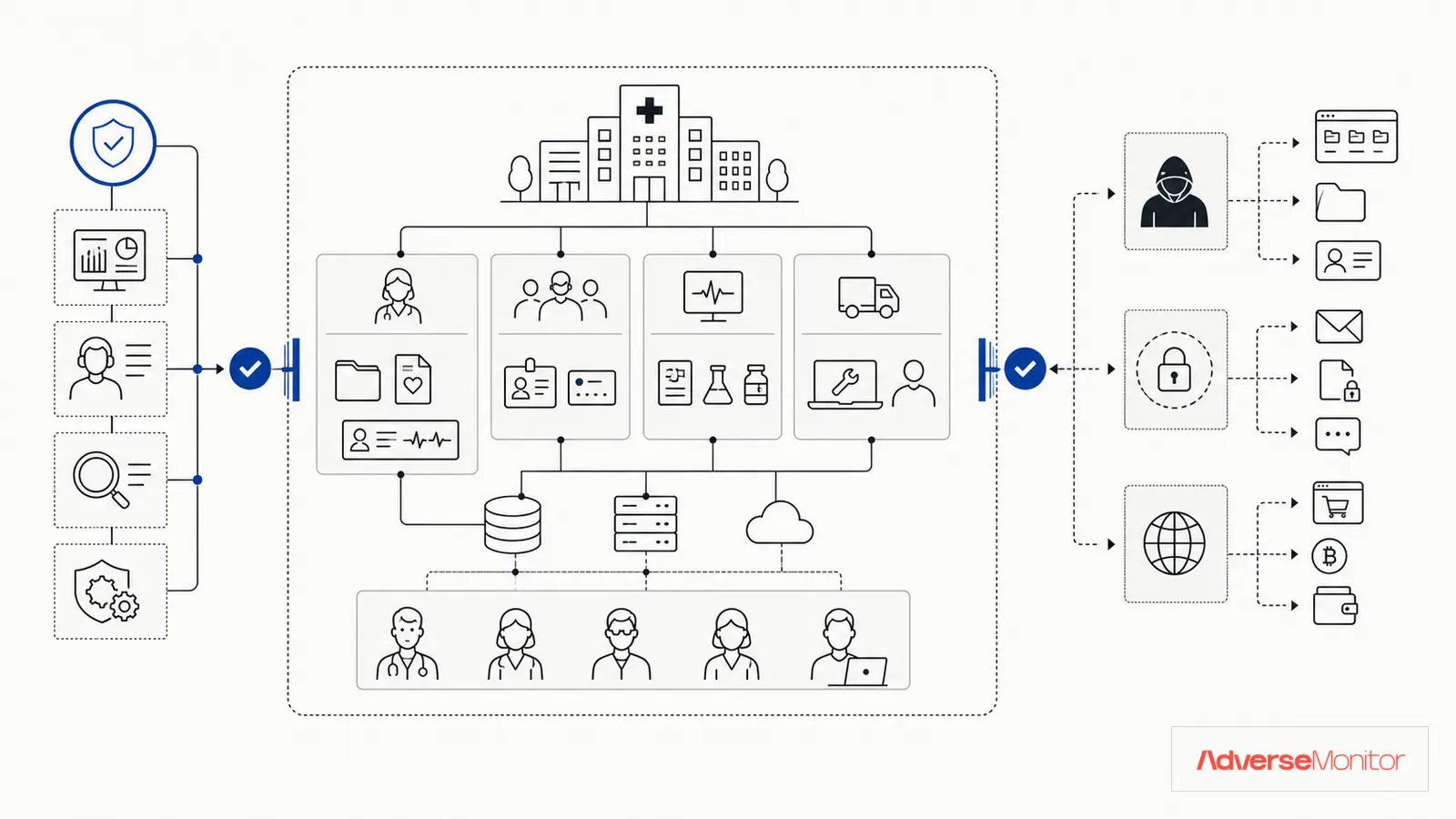
Healthcare organizations store identity, insurance, payment, and clinical data while running systems that clinicians need for patient care. Legacy software and hard-to-patch medical devices add to the exposure. Criminal markets can monetize both the data and access to the network.
A healthcare incident can combine operational disruption with notification, legal, clinical-continuity, and recovery work. Public cost studies are useful context, but they are not a forecast for an individual provider.
Why Healthcare Data Is Valuable
A medical record may contain several types of information that a criminal can reuse. Marketplace asking prices vary by source, freshness, completeness, and whether the seller's claim is genuine, so this article does not assign a fixed resale value.
Identity Profiles: Medical records can contain names, dates of birth, social security numbers, addresses, phone numbers, insurance information, and payment details. Sellers may package these fields together as "fullz."
Long-Lasting Value: Unlike credit cards that can be quickly canceled when compromised, medical records remain valid for years. Personal information like social security numbers and dates of birth cannot be changed, providing long-term value to criminals.
Several Fraud Uses: Criminals can use healthcare data for insurance fraud, prescription fraud, medical identity theft, or financial identity theft.
Detection can be delayed: A patient may first notice misuse through an unfamiliar bill, insurance issue, or incorrect information in a medical record.
Check the current public record:
The HHS breach portal publishes reported breaches affecting 500 or more individuals. Use the portal or HHS reports for dated counts rather than carrying an old total into an incident decision.
Common Attack Vectors Targeting Healthcare
Ransomware Attacks
Ransomware operators target healthcare providers because an outage can interrupt access to electronic health records, imaging, and other clinical systems. That operational pressure becomes part of the extortion attempt.
Some healthcare ransomware attacks combine encryption with theft of patient data. Backups may restore systems, but threatened publication of protected health information can still trigger legal and regulatory work.
Major ransomware groups like LockBit, BlackCat, and Hive have specifically targeted healthcare providers, with some attacks forcing emergency room diversions and surgical cancellations.
Phishing and Social Engineering
Healthcare workers face constant phishing attempts designed to steal credentials or deliver malware. Attackers craft emails impersonating insurance companies, medical device vendors, pharmaceutical companies, or even hospital administrators.
Staff working under time pressure may have less time to inspect a message that appears to come from an insurer, vendor, or administrator. Training and technical email controls should account for that workflow.
Insider Threats
Healthcare organizations also plan for insider misuse and compromised staff accounts. Examples include:
- Malicious insiders stealing patient data for sale on dark web markets
- Staff accessing celebrity or VIP patient records out of curiosity
- Employees compromised through social engineering providing access to attackers
- Contractors or temporary staff with inadequate vetting
Doctors, nurses, billing staff, and administrators need different levels of system access. Role-based permissions and access reviews help limit unnecessary access.
Third-Party and Supply Chain Compromise
Healthcare organizations rely on extensive networks of vendors: electronic health record providers, medical device manufacturers, billing services, insurance companies, pharmacy systems, and more. Each represents a potential attack vector.
When a healthcare vendor is compromised, attackers gain access to multiple healthcare organizations simultaneously. Several major healthcare breaches in recent years originated from compromised business associates rather than direct attacks.
Medical Device Vulnerabilities
Some infusion pumps, imaging systems, and diagnostic devices run older operating systems with known vulnerabilities. A patch may require vendor support or recertification.
An attacker may use a vulnerable device as an entry point and then try to reach other systems. Reports of attackers manipulating treatment through such devices remain rare.
What Happens to Stolen Healthcare Data
Once healthcare data is stolen, it flows through dark web marketplaces:
Initial Sale: Fresh healthcare data dumps sell for premium prices on dark web forums. Sellers advertise the number of records, types of data included, and healthcare provider names.
Medical Identity Theft: Criminals use stolen identities to obtain medical services, prescription drugs (particularly opioids), or medical equipment that's then resold.
Insurance Fraud: Fraudulent insurance claims are filed using stolen patient information, with reimbursements going to criminal-controlled accounts or pharmacies.
Targeted Scams: Healthcare data enables highly targeted phishing and social engineering attacks against patients, using accurate medical information to increase credibility.
Persistent Access Sales: An attacker who leaves a backdoor may advertise that access to another criminal, including a ransomware operator.
Regulatory Compliance and HIPAA
Healthcare organizations face unique regulatory requirements under HIPAA (Health Insurance Portability and Accountability Act) that create additional pressure:
Breach Notification: The HHS Breach Notification Rule guidance covers notice to affected individuals, HHS, and, in some cases, the media. HHS reporting applies above and below 500 affected individuals, with different timing.
Enforcement: Penalty amounts are adjusted and depend on the violation and enforcement findings. Check current HHS material and obtain legal advice instead of relying on a fixed range in a security article.
Legal review: The facts may raise civil, contractual, state, or criminal-law questions. Counsel should identify which rules apply.
Reputation Damage: Healthcare breaches receive significant media attention, damaging patient trust and potentially impacting patient volume.
Claims and contracts: An incident can also create patient claims, insurance conditions, and vendor-notification duties. Scope them from the affected data and agreements.
Protecting Healthcare Organizations
Healthcare-specific security measures should include:
Dark Web Monitoring: Continuous monitoring of dark web forums, ransomware leak sites, and credential marketplaces for mentions of your organization or patient data. Early detection allows faster response and mitigation.
Access Controls: Implement role-based access control ensuring staff only access data necessary for their jobs. Regularly audit access logs for inappropriate record access.
Multi-Factor Authentication: Require MFA for all access to systems containing PHI, particularly for remote access and administrative accounts.
Risk Analysis: Keep the risk analysis current as the environment changes. HHS explains that the Security Rule does not set one frequency for every covered entity.
Employee Training: Provide regular security awareness training covering phishing recognition, password security, social engineering, and proper handling of PHI.
Incident Response Planning: Develop and test incident response plans specifically addressing ransomware scenarios, data breaches, and HIPAA breach notification requirements.
Network Segmentation: Separate medical devices, administrative systems, and guest networks to limit lateral movement if one segment is compromised.
Vendor Risk Management: Thoroughly vet business associates, require security assessments, include security requirements in contracts, and monitor vendors for breaches.
Encryption: Encrypt data at rest and in transit. While not a substitute for other controls, encryption can mitigate some breach consequences under HIPAA's "safe harbor" provisions.
Recovery Copies: Maintain protected, tested recovery copies for critical systems, including electronic health records. Backups support recovery but do not replace containment, access control, or notification work.
Emerging Threats in Healthcare
AI-Assisted Attacks: Attackers can use AI tools to draft phishing messages or assist reconnaissance. Healthcare teams should judge the message and behavior rather than rely on poor grammar as a warning sign.
Cloud Security Challenges: As healthcare moves to cloud-based EHR systems and telehealth platforms, new security challenges emerge around multi-tenancy, API security, and cloud misconfigurations.
IoT Medical Devices: Each connected medical device adds another system to inventory, configure, patch, and monitor. Some devices offer limited security controls.
Telehealth: Include telehealth platforms, identities, integrations, and vendors in the same inventory and risk process as other clinical systems.
Genetic Data Targeting: As genetic testing becomes common, genomic data represents a new high-value target. Unlike other personal information, genetic data is immutable and highly sensitive.
The Cost of Healthcare Breaches
IBM's healthcare review for its 2024 breach-cost study reported the highest industry average in that edition. Treat that study result as a benchmark tied to its sample and year.
- Direct Costs: Forensic investigation, legal fees, regulatory fines, breach notification, credit monitoring for affected patients
- Operational Impact: System downtime, diverted patients, delayed procedures, lost revenue
- Long-Term Costs: Reputation damage, patient attrition, increased insurance premiums, ongoing monitoring
- Regulatory Penalties: HIPAA fines, state-level penalties, OCR investigations
A provider's actual cost depends on clinical disruption, affected data, recovery time, applicable notice duties, and the support already under contract.
Conclusion
Medical data has several resale and fraud uses, while healthcare outages can disrupt clinical work. Those conditions keep healthcare providers on ransomware and data-theft target lists.
Use access controls, staff training, vendor reviews, backups, and monitoring as separate parts of the security program. Analysts must validate a relevant dark web match before deciding whether it reflects an organizational compromise.
Incident plans should cover the systems clinicians need to continue patient care, as well as the notification and investigation work required after a data exposure.