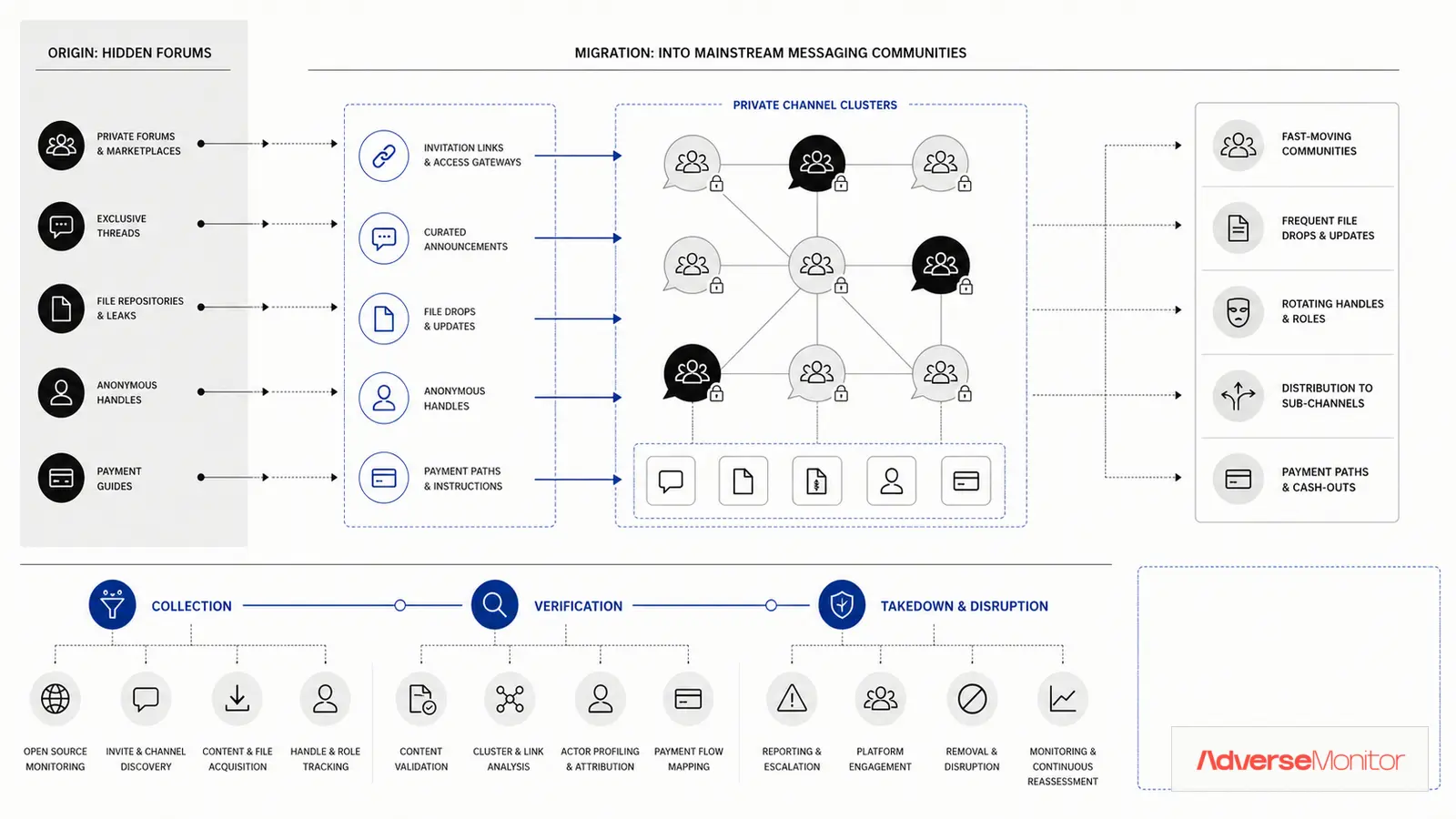
Cybercriminals use Telegram and Discord alongside .onion sites and underground forums. Public channels, private groups, direct messages, bots, and file hosting can support data sales, negotiations, and coordination.
The apps are easy to join. They offer fast messaging, file sharing, and automation. Those same features make monitoring harder for security teams.
From Tor sites to messaging apps
What Tor sites offered
For more than a decade, criminals have used Tor and .onion domains for marketplaces and forums. Those sites offered:
- Anonymity: Tor routing hides IP addresses and location
- Persistence: Dedicated marketplaces and forums with established reputations
- Community: Vetted members, escrow services, and dispute resolution
Limits of Tor sites
Dark web sites can disappear after a law-enforcement action or an exit scam. Users also need extra software to reach them. Investigators have identified operators who relied on Tor for anonymity.
What Telegram and Discord add
Mainstream messaging apps offer cybercriminals several advantages:
- Lower access barrier: Users install an app and create an account. They do not need a Tor browser.
- Mobile-first: Criminals can run their business from a phone anywhere in the world.
- Built-in features: File sharing, bots, channels, and groups.
- Encryption: End-to-end encryption in Telegram's "secret chats" and Discord DMs.
- Legitimacy: Billions of legitimate users provide cover.
- Resilience: Law enforcement can take down a single dark web site more easily than a whole platform.
Telegram channels and Discord servers can appear in cybercrime investigations. Neither platform is itself a dark web service. Access, moderation, and source reliability vary by community.
Criminal activity on Telegram
Security researchers have documented criminal activity in Telegram channels, groups, and bots.
Ransomware operations
Ransomware groups use Telegram more and more for:
- Victim negotiations: Some groups now negotiate with victims on Telegram instead of on .onion payment sites.
- Data leak announcements: Channels with thousands of subscribers share stolen data dumps.
- Affiliate recruitment: Ransomware-as-a-Service operators recruit "affiliates" to deploy their malware.
- Status updates: Groups announce new victims, new features, and changes to how they operate.
LockBit, BlackCat/ALPHV, and Play have all kept active Telegram channels. Some ran them alongside traditional leak sites, and some ran them instead of one.
Data marketplaces
Telegram channels serve as markets where people buy and sell stolen information. Common listings include:
- Credential dumps: "Combolists" with millions of username:password pairs
- Database leaks: Customer records from breached companies
- Initial access: Compromised VPN credentials, RDP access, corporate email accounts
- Financial data: Credit card numbers, bank account details, cryptocurrency wallets
- Personal information: Social security numbers, driver's licenses, passports
Sellers advertise in public channels, then move to private chats to close the deal. Payment is usually cryptocurrency, sent directly between the two parties.
Hacking services
Telegram hosts a gig economy for cybercrime. Services on offer include:
- DDoS-for-hire: "Booter" services that advertise attack capacity
- Phishing kits: Ready-made templates for stealing credentials
- Malware development: Custom RATs, stealers, and trojans
- Account takeover: Services that break into specific social media or email accounts
- CAPTCHA solving: Human workers who solve CAPTCHAs for bot operators
Automated bots
Criminals use Telegram's bot API to automate their services:
- Leak check bots: Check whether an email address appears in breaches
- Carding bots: Test whether stolen credit card numbers are valid
- Doxing bots: Look up personal information from databases
- Phone number lookup: Find personal details linked to a phone number
With these bots, a buyer can query stolen data or validate payment-card details without building a separate tool.
Criminal activity on Discord
Discord started as a home for gaming communities, and it has seen similar abuse. Telegram is more popular for data trading. Discord stands out as a coordination platform.
Threat actor collaboration
- Private servers: Invite-only communities where threat actors share techniques and tools
- Real-time coordination: Voice channels to plan and carry out attacks
- File sharing: Malware samples, stolen data, and hacking tools shared through Discord's CDN
- Tutorials and training: Channels that teach exploitation techniques to newcomers
Social engineering operations
Discord's young user base makes it attractive for scams:
- Cryptocurrency scams: Fake investment offers and pump-and-dump schemes
- Account takeover: Theft of high-value gaming accounts, NFTs, and cryptocurrency wallets
- Tech support scams: Fake platform staff who steal credentials
- Romance scams: Fake relationships used to extract money or information
Malware distribution
Attackers abuse Discord's content delivery network (CDN) to host malware:
- Remote Access Trojans (RATs): Malware payloads disguised as legitimate files
- Information stealers: Tools built to extract credentials and cryptocurrency wallets
- Phishing payloads: Files that lead to credential-harvesting sites
Discord's CDN uses HTTPS, and many legitimate users access it. As a result, malware hosted there often gets past security filters.
Why criminals use these platforms
Five factors explain why criminals use these apps alongside traditional dark web sites.
1. Law enforcement pressure
Law enforcement shut down marketplaces including AlphaBay, Hansa, and Silk Road. Closing one channel or server does not shut down a whole messaging platform.
2. Generational shift
Younger threat actors grew up with mobile messaging apps. Telegram's interface feels more familiar to them than dark web forums. For them, the barrier to entry is lower.
3. Speed and convenience
A forum transaction can involve private messages and escrow. Messaging apps support direct, near-real-time negotiation.
4. Platform policies
Enforcement and cooperation with authorities vary by platform and jurisdiction. Criminal groups take advantage of channels or servers that stay up long enough to reach buyers.
5. Better features
Criminal users repurpose ordinary platform features:
- Channel broadcasts can reach subscribed members fast
- Bots automate tasks that used to be manual
- File sharing is faster and more reliable
- Mobile apps make 24/7 operations possible
Challenges for security teams
This shift creates new problems for security professionals.
Monitoring is more complex
Dark web monitoring used to focus on .onion sites and known forums. Now you also need to monitor:
- Public Telegram channels (relatively easy)
- Private Telegram groups (requires infiltration)
- Discord servers (often invite-only)
- Encrypted direct messages (nearly impossible)
Volume is higher
Lower barriers to entry mean more threats surface on these platforms. Amateur criminals mix with skilled actors, so security teams have more noise to filter.
Speed demands fast response
A credential post in a large public channel can reach many subscribers fast. Set your monitoring and triage intervals to match that speed.
Review Matches From Collected Threat Sources
AdverseMonitor tracks publicly posted cyber-incident claims: ransomware and extortion leak-site posts, data-breach and data-leak listings, DDoS, defacement and initial-access offers, drawn from sources including Telegram channels, Tor sites and the open web, and records a match, and alerts you by email, Slack, Microsoft Teams or phone push, when your organisation, domain, industry or country is named. AdverseMonitor does not check whether a specific email address or credential was exposed.
Check a DomainWhat organizations should do
1. Expand your monitoring scope
Ask a monitoring service which sources it covers. Some cover only .onion sites. Others also collect from relevant public messaging and paste sources. Useful source types include:
- Public Telegram channels known for data leaks
- Discord communities linked to your industry
- Paste sites where people share data in public
- Traditional dark web forums and marketplaces
2. Reduce alert latency
Set shorter alert intervals for high-priority terms. Decide who reviews a domain match and how fast that person should open the source evidence.
3. Monitor for specific indicators
- Your company name and common misspellings
- All corporate domains and subdomains
- Executive names (often targeted for whaling attacks)
- Product names and intellectual property
- Employee email addresses
4. Establish response procedures
Write down the steps your team takes after a relevant Telegram match:
- Verification: Confirm the threat is real and assess its severity.
- Containment: Force password resets and disable compromised accounts.
- Investigation: Find the breach source and scope.
- Documentation: Preserve evidence for possible legal action.
- Notification: Inform affected parties as regulations require.
5. Educate your team
Security awareness training should cover:
- Risks of using corporate credentials on personal devices
- Dangers of joining work-related Discord or Telegram groups with unverified members
- Ways information shared in "private" groups can leak
- Social engineering tactics specific to messaging platforms
How the platforms respond
Telegram and Discord use different moderation and law-enforcement processes.
Telegram's position
Critics accuse Telegram of harboring criminal activity. Telegram's approach:
- Removes "clearly illegal" content when users flag it
- Does not proactively scan for criminal activity
- Limits cooperation with law enforcement
- Defends user privacy and free speech as primary values
Critics argue this hands-off approach enables crime. Supporters say it protects legitimate users under authoritarian regimes.
Discord's efforts
Discord has responded more actively:
- Shuts down servers reported for illegal activity
- Uses automated tools to detect malware distribution
- Cooperates with law enforcement investigations
- Has published transparency reports on its takedowns
Hundreds of millions of users generate more activity than moderators can review by hand.
Looking ahead
Policy changes, regulation, and law-enforcement activity will affect where criminal groups operate next.
Regulatory pressure
Governments pay growing attention to the role encrypted platforms play in crime. The EU's Digital Services Act and similar rules may force platforms to take stronger action.
Platform policies
If Telegram and Discord tighten enforcement, criminals may move to decentralized platforms or return to dark web forums.
Law enforcement adaptation
Police agencies are building the skills to monitor and infiltrate Telegram and Discord communities. That work may make the platforms less appealing to criminals.
Define the monitoring scope
Criminal groups pick channels that make it easy to find buyers, share files, and coordinate. Telegram and Discord provide some of those functions.
Sources to consider
A source plan may include:
- Classic dark web (.onion sites, forums)
- Telegram channels and groups
- Discord servers and communities
- Paste sites and data dump platforms
- Social media where leaks are announced
Telegram and Discord sit on the public internet. Criminals may still use them for the same deals you find on underground forums.
What to write down
- Which source types matter to your organization
- How your team collects them
- How analysts validate a match