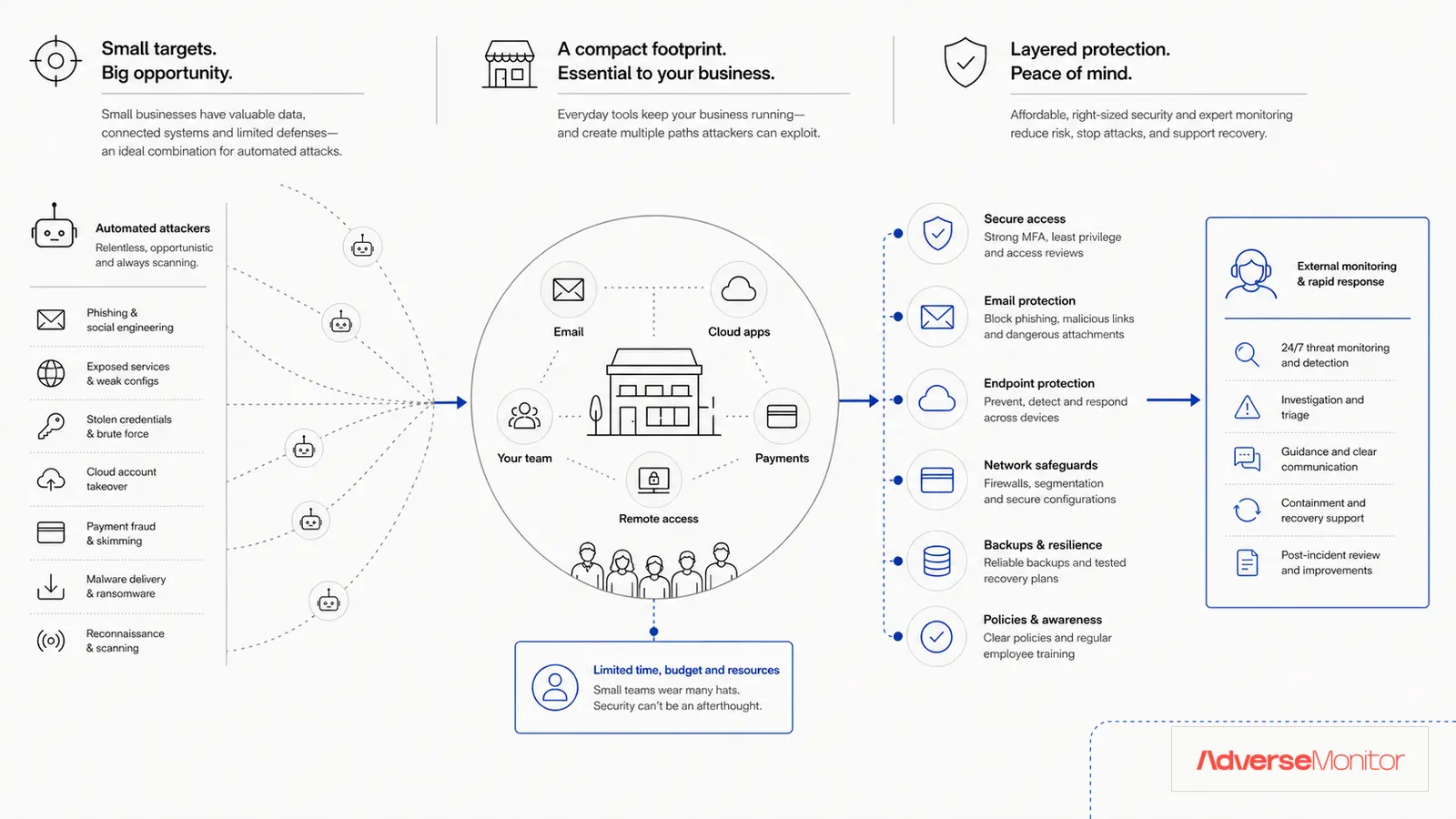
Verizon's 2024 Data Breach Investigations Report covers incidents and confirmed breaches across organizations of different sizes. It does not support turning that dataset into a universal percentage of attacks aimed at small businesses.
Small and mid-sized businesses often have fewer security staff and less monitoring coverage than larger enterprises. Attackers look for the gaps that follow.
Why SMBs Are Attractive Targets
1. Weaker Security Posture
SMBs typically have fewer resources dedicated to cybersecurity compared to large enterprises. Common gaps include:
- No dedicated security staff or CISO
- Outdated or unpatched systems
- Minimal security awareness training
- Lack of multi-factor authentication
- Insufficient network monitoring and logging
- No formal incident response plan
Attackers scan internet-facing systems for outdated software, weak passwords, and exposed remote access. These gaps appear often in environments with limited IT staffing.
2. Supply Chain Access
Many SMBs provide services to larger enterprises. An attacker may use access to the smaller provider as a route into a customer environment. This is one form of a supply chain attack.
If your small accounting firm handles financials for Fortune 500 clients, or your engineering company has access to a manufacturer's design systems, you become a valuable target regardless of your own size.
3. Lower Detection Rates
SMBs typically lack sophisticated monitoring and detection capabilities that larger organizations deploy. Attackers can maintain access longer, exfiltrate more data, and cause more damage before being discovered.
A small team should measure its own time from signal to review and containment. Public averages do not show whether its logs, owners, and escalation path will work during an incident.
4. Payment Likelihood
Ransomware can put severe operational pressure on a small business. Factors that make recovery harder include:
- Often lack adequate backups
- May exhaust their cash reserves during an extended outage
- Don't have cyber insurance with breach response support
- Face existential threats from prolonged outages
A manufacturer that loses production systems for a week may face enough lost revenue and recovery cost to consider paying, even though payment does not guarantee recovery.
5. Valuable Data Despite Size
SMBs hold valuable data that's attractive to criminals:
- Customer payment information and credit cards
- Employee personal information (W-2s, SSNs)
- Intellectual property and trade secrets
- Client data held on behalf of larger companies
- Business bank account credentials
A law firm with a dozen employees may still hold sensitive information for hundreds of clients. Attackers value the data and client access, not the firm's headcount.
6. Lack of Cybersecurity Insurance
Many SMBs do not carry cyber insurance, so uninsured organizations bear more of the direct breach cost. Their ability to absorb that cost depends on cash reserves, recovery time, and available support.
Even when SMBs have coverage, limits are often insufficient to cover full breach costs including forensics, legal fees, notification, credit monitoring, and business interruption.
Model your own interruption:
Estimate recovery from the systems, staff, vendor support, cash flow, and contracts the business actually has. A broad public average is not a reliable forecast for one small company.
Common Attack Vectors Against SMBs
Phishing and Business Email Compromise
Attackers send messages impersonating vendors, clients, or executives to steal credentials or trick employees into transferring money.
A fraudulent transfer can consume a larger share of cash at a smaller company. Use dual approval and verify payment-detail changes through a known contact route.
Ransomware
Ransomware-as-a-Service lets affiliates use shared infrastructure and playbooks. The demand varies with the victim and actor, and payment does not guarantee recovery.
Credential Stuffing
Attackers purchase credential lists from dark web marketplaces and test them against SMB systems. Because employees often reuse passwords, these attacks frequently succeed.
Remote Access Exploitation
Many SMBs implemented quick remote access solutions during the pandemic without proper security controls. Attackers scan for exposed RDP (Remote Desktop Protocol) connections, VPNs with default credentials, and unsecured remote access tools.
Vendor Impersonation
Attackers impersonate trusted vendors via email or phone, requesting payment information updates or credential verification. SMBs with limited vendor management processes are particularly vulnerable.
The Dark Web and SMBs
SMB data circulates on dark web marketplaces just like enterprise data:
Credential Sales: Employee credentials for SMB systems are sold in bulk and individually. SMB admin credentials command premium prices if they provide access to client systems.
Database Dumps: Customer databases from SMB breaches are sold on dark web forums. Even small customer lists have value.
Ransomware Leak Sites: A ransomware group may publish client information or proprietary business data after a victim refuses payment.
Access Sales: Initial access brokers may advertise access to a compromised business. Asking prices and seller claims vary and require verification.
Protecting Your SMB
Smaller teams can begin with controls that cover common entry points and recovery needs:
Implement Multi-Factor Authentication: Require MFA for email, VPN, administrative access, and financial systems. MFA blocks password-only login attempts when a credential is stolen.
Recovery Copies: Maintain protected backups of critical systems and test restoration on a schedule that fits recovery requirements.
Security Awareness Training: Train employees to recognize phishing emails, verify unusual payment requests, and report suspicious activity. Use phishing simulations and reports to measure whether the training changes behavior.
Patch Management: Keep systems updated, prioritizing internet-facing systems and known-exploited vulnerabilities. Many SMB breaches exploit vulnerabilities with available patches.
Dark Web Monitoring: Review cyber-incident records that name your company. AdverseMonitor does not check whether a specific email address or credential was exposed. Treat a match as a lead and validate the available evidence before acting.
Email Security: Use email filtering and configure SPF, DKIM, and DMARC. Pair those controls with a process for staff to report suspicious messages.
Access Control: Limit who can access sensitive data and financial systems. Require dual approval for financial transactions above thresholds.
Vendor Management: Verify changes to vendor payment information through known contact numbers (not information in the request). Implement vendor security requirements in contracts.
Incident Response Planning: Have a simple IR plan documenting who to call (IT support, attorney, cyber insurer) and what to do when an incident occurs.
Cyber Insurance: Review whether a policy fits the business, including exclusions, response providers, notification duties, limits, and recovery support.
Budget-Friendly Security for SMBs
A small team can compare free or lower-cost controls before adding managed services:
Free/Low-Cost Tools:
- Microsoft Defender (included with Windows)
- Multi-factor authentication (built into most platforms)
- Cloud-based email filtering (many affordable options)
- Monitoring services whose current scope and published price fit the watchlist
Managed Security Services: Compare an outsourced monitoring service with the cost and coverage of an internal hire. Check who reviews alerts and what happens outside business hours.
Security Consultants: A periodic assessment can help a small team identify gaps without adding a permanent role. Scope and follow-up determine its value.
The SMB Advantage
Smaller organizations may also have practical advantages:
Shorter approval paths: A small leadership team may approve a security change without several review layers.
Smaller inventory: Fewer systems can make asset ownership and access reviews easier to manage.
Direct communication: Staff can verify an unusual request with a colleague or manager through a known channel.
Vendor contacts: A known contact gives the team a separate route for checking a payment or account-change request.
Conclusion
Attackers assess exposed systems, reusable credentials, valuable data, and access to customers. A small company can meet those conditions even when it has little public profile.
Start with MFA and tested backups, then build a repeatable patching and monitoring routine. Assign an owner and a review date to each control so gaps do not sit unnoticed.
Use the attack paths in this article to set priorities, then test whether the selected controls work in your own environment.