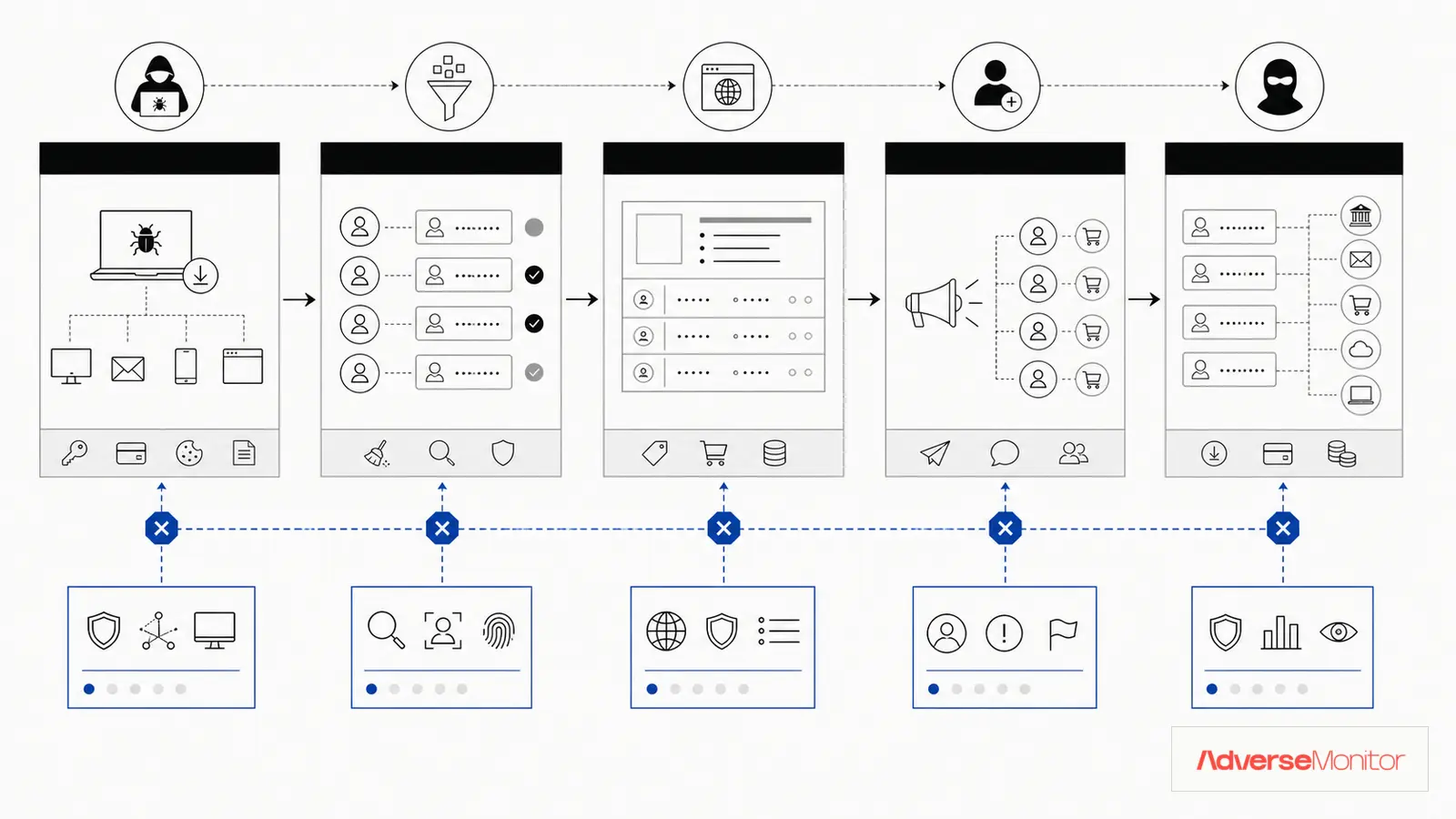
Attackers buy and sell stolen credentials through forums, automated shops, messaging channels, and private deals. A credential may pass through several sellers before another criminal uses it for fraud or network access.
Some marketplaces use fixed prices, seller reviews, escrow, and support channels. This article follows a credential from theft through resale and use.
The Credential Marketplace Ecosystem
Credentials stolen through phishing, malware, or a database breach may move through several types of seller:
Tier 1: Initial Collectors - Attackers who steal credentials through breaches, malware, or phishing operations
Tier 2: Wholesale Brokers - Bulk purchasers who buy large credential dumps and resell them in smaller quantities
Tier 3: Retail Sellers - Individuals selling specific high-value credentials or curated lists
Tier 4: End Users - Criminals who purchase credentials to conduct fraud, account takeovers, or further attacks
Where Credentials Are Sold
Dark Web Forums
Underground forums like BreachForums, XSS, and Exploit.in host dedicated marketplace sections where credentials are traded. These forums operate with:
- Reputation systems (vendor ratings and reviews)
- Escrow services to prevent scams
- Dispute resolution processes
- Dedicated administrators who enforce marketplace rules
Entry to many of these forums requires invitations, proof of skills, or payment, creating trusted communities of criminals.
Automated Shops
Some operators run automated credential shops, often on the dark web. A buyer can search inventory, pay with cryptocurrency, and receive the purchased data through the site.
Telegram Channels
Increasingly, credential sales happen through Telegram channels and bots. Sellers advertise fresh credential dumps, and buyers purchase through automated systems. Telegram's encryption and ease of use make it attractive for this market.
Paste Sites
Some attackers dump credentials on paste sites (like Pastebin) for free, either as proof of breach, reputation building, or because the data is old. These "combolists" are then aggregated by others for resale or credential stuffing attacks.
Types of Credential Products
Combolists
Combolists aggregate email-and-password pairs from several breaches. Sellers offer bulk lists for credential-stuffing attacks, but many entries may be old or invalid.
Fresh Dumps
Sellers may describe recently stolen credentials as more valuable. The asking price depends on the claimed target, freshness, access, and seller reputation, and the claim may be false.
Categorized Credentials
Credentials organized by company, industry, or domain. For example, "Fortune 500 corporate email credentials" or "healthcare provider logins." These curated lists command higher prices than random combolists.
Premium Access
Administrative credentials, VPN access, or credentials for high-value accounts may be advertised individually. Asking prices vary with the claimed access, target, freshness, and seller reputation.
Fullz
Complete identity packages may combine credentials with names, addresses, identification numbers, card details, and security answers. The contents and authenticity vary by seller.
Pricing Models
Credential pricing follows supply and demand economics:
Common Listing Categories:
- Combolists: older username and password pairs packaged in bulk
- Fresh credential dumps: recently collected account data
- Corporate email credentials: accounts tied to an organization
- Financial accounts: access claims involving banking or payment services
- VPN or remote desktop access: claimed entry into a business network
- Administrative credentials: accounts with elevated permissions
- Cryptocurrency accounts: access claims involving exchanges or wallets
Prices fluctuate based on:
- Freshness: Newer credentials worth more (likely unchanged)
- Validity: Verified working credentials command premiums
- Target Value: High-revenue companies or wealthy individuals
- Access Level: Admin rights worth 10-100x standard user credentials
- Supply: Rare credentials (government, military, major banks) are premium
The Business Model
Subscription Services
Some sellers charge a monthly subscription for access to databases that they update with new credential dumps.
Verification Services
Third parties may test whether credentials still work before purchase and charge for each check.
Credential Stuffing Tools
Automated tools can test credentials across many services. Tool access may itself be sold, while buyers use the results to find reused passwords.
Support and Training
Sophisticated sellers provide customer support, tutorials on using credentials, and even training on monetization techniques. This "professionalization" makes the market accessible to less technical criminals.
How Credentials Are Validated
Buyers want assurance they're purchasing working credentials. Sellers use several methods:
Sample Credentials: Providing a small number of free credentials from the batch as proof
Screenshots: Showing successful logins to prove validity
Automated Checking: Running credentials through verification tools and sharing results
Escrow Systems: Third-party holds payment until buyer confirms credentials work
Reputation: Established sellers with positive reviews command trust and higher prices
Payment Methods
Cryptocurrency dominates credential marketplace payments:
Cryptocurrency: Sellers may request assets such as Bitcoin, while transactions can still leave records investigators use.
Monero: Privacy-focused cryptocurrency preferred for anonymity
Ethereum & Altcoins: Alternative options with varying anonymity
Cryptocurrency Mixers: Services that obscure transaction origins, adding anonymity layer
Some sellers accept gift cards, prepaid debit cards, or other cryptocurrencies. Payment method choice balances anonymity, convenience, and transaction fees.
How Organizations End Up in These Markets
Your credentials reach these marketplaces through multiple vectors:
Direct Database Breaches: Attackers breach your systems and steal credential databases
Phishing Campaigns: Employees tricked into providing credentials through fake login pages
Malware/Infostealers: Malware captures credentials as users enter them or from browser storage
Third-Party Breaches: Vendors or partners get breached, exposing credentials your employees used on their platforms
Password Reuse: Employees reuse corporate passwords on personal sites that get breached
Insider Threats: Malicious or compromised employees sell credentials directly
The Credential Lifecycle
A credential may move through several stages, but there is no fixed timetable:
- Collection: Credentials are taken through a breach, phishing, malware, or another access path.
- Use or sale: The collector may test the account, retain it, or offer it to another buyer.
- Verification and sorting: A broker may test entries and group them by organization or service.
- Resale: The same entry may appear in several packages or services.
- Aggregation: Older entries may be added to larger combolists used for password-reuse attacks.
A listing price does not show whether the credential works, whether it has already been reset, or whether the seller possesses the claimed access.
Protecting Against Credential Theft
Understanding this economy informs defensive strategies:
Multi-Factor Authentication: Blocks a password-only login when the attacker lacks the required factor. Phishing-resistant methods offer stronger protection against interception and session theft.
Password Policies: Require unique passwords, screen new passwords against known compromised values, support password managers, and force a change when compromise is suspected rather than on an arbitrary routine.
Dark Web Monitoring: Surface available records that match the organization's terms, then verify the account and source before applying the response process.
Employee Training: Educate staff about phishing, password reuse dangers, and social engineering tactics.
Breach Detection: Fast detection limits how much data can be stolen before access is cut off.
Zero Trust Architecture: Assume credentials will be compromised; limit what they can access.
Anomaly Detection: Monitor for unusual login patterns (geographic anomalies, time-of-day oddities, impossible travel).
Regular Access Reviews: Disable unused accounts; former employees' credentials frequently appear in marketplaces.
What Happens When Credentials Are Used
Purchased credentials enable various attacks:
Account Takeovers: Access customer accounts to steal data, make fraudulent purchases, or conduct financial fraud
Business Email Compromise: Impersonate executives to authorize fraudulent wire transfers
Ransomware Deployment: Use VPN credentials to access networks and deploy ransomware
Data Theft: Steal intellectual property, customer databases, or other sensitive information
Lateral Movement: Use compromised employee accounts to access additional systems and escalate privileges
Credential Stuffing at Scale: Test credentials across thousands of sites to find additional valid accounts
The Evolving Market
The credential marketplace continues to evolve:
Increased Automation: Bots handle everything from theft through sale to validation
Specialization: Vendors focusing on specific industries (healthcare, financial services) or credential types
Quality Over Quantity: Shift toward fewer, higher-quality verified credentials rather than massive unverified dumps
Integrated Services: Bundling credentials with access methods, bypass techniques, or monetization guidance
AI-Enhanced: Using AI to curate credentials, predict which are most valuable, and optimize pricing
Conclusion
Credential markets divide the work of theft, sorting, validation, resale, and use among different participants. Defenders should account for the full path rather than treating the original breach as the end of the incident.
Organizations can prepare for credential exposure by requiring MFA, watching authentication logs, and defining when to reset an affected account.
A relevant monitoring match can point an analyst to credential-related source evidence. The analyst still needs to validate the match, identify the affected account, and check for unauthorized access.
MFA and limited account privileges can reduce what an attacker can do with a stolen password. Monitoring and authentication logs help the team decide which accounts need investigation.